With President Muizzu weakened after the referendum defeat, the MDP fractured over its nominee, and Yameen plotting a comeback, the 2028 presidential race is shaping up to be the most consequential election since the dawn of Maldivian multi-party democracy in 2008.
Mohamed Zahir
Editor-in-Chief
April 16, 2026
18 min read
I. The Political Landscape: A Nation at a Crossroads
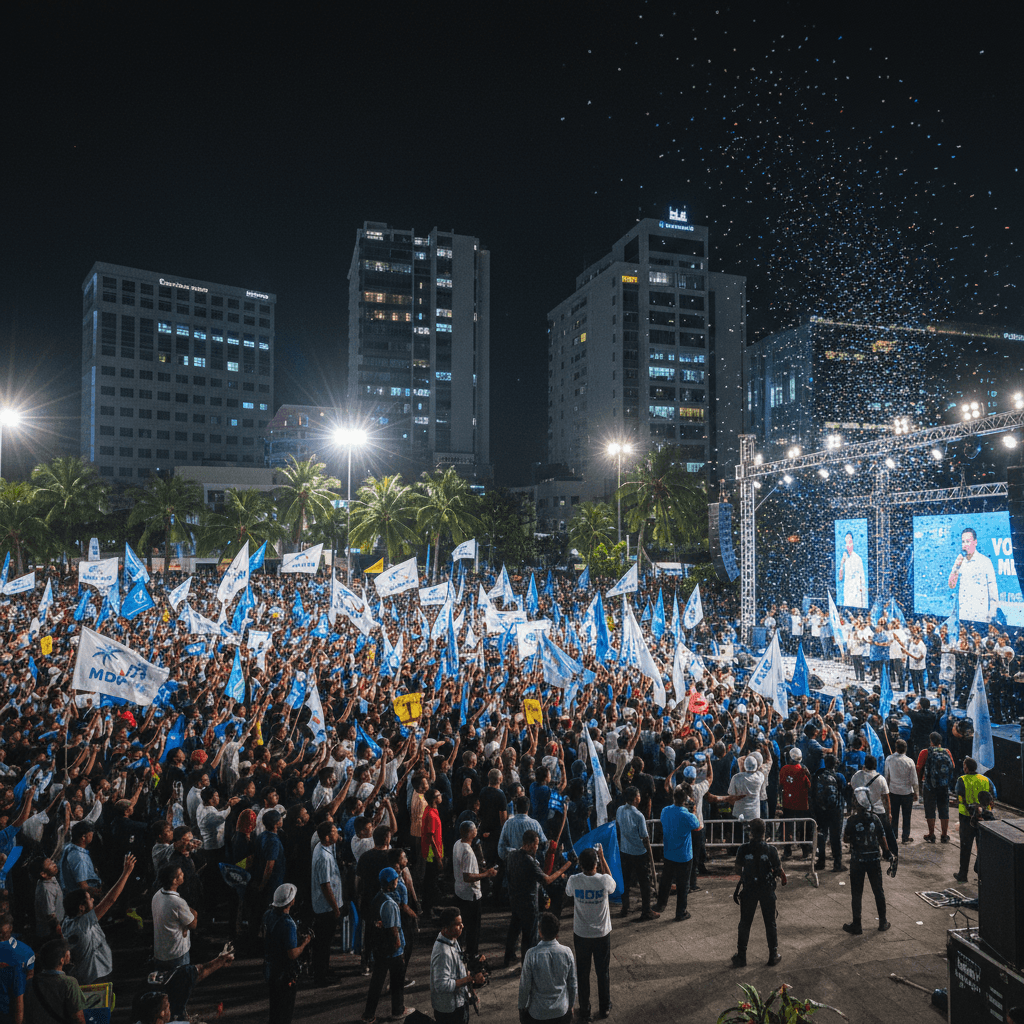
The Maldives enters the 2028 election cycle in a state of profound political flux. The April 2026 local elections and constitutional referendum delivered a seismic shock to the ruling establishment: President Mohamed Muizzu's PNC lost the popular vote to the opposition MDP (38.9% vs 42.9%), was swept in all five mayoral races, and watched its signature constitutional amendment — concurrent elections — rejected by 68.7% of voters.
These results have fundamentally altered the political calculus for every major player. What was expected to be a straightforward re-election bid for Muizzu has transformed into a wide-open contest that could feature up to four former or current presidents on the ballot.
April 2026 Elections: By the Numbers
MDP Vote Share
42.9%
246 council seats
PNC Vote Share
38.9%
220 council seats
Referendum Result
68.7% No
148,859 against
Voter Turnout
74.98%
221,111 of 294,876
II. The Contenders
Mohamed Muizzu
Incumbent President
Confirmed nominee
Abdulla Shahid
Party President, Former FM & UNGA President
Declared for primary
Mohamed Nasheed
Former President (2008-2012)
Declared for primary
Abdulla Yameen
Former President (2013-2018)
Declared candidate
1. Mohamed Muizzu (PNC) — The Embattled Incumbent
President Muizzu came to power in September 2023 with a decisive victory over Ibrahim Mohamed Solih, riding a wave of nationalist “India Out” sentiment and promises of economic reform. His PNC secured a parliamentary supermajority in the 2024 elections with 66 of 93 seats — seemingly granting him an unassailable mandate.
Yet by mid-2026, that mandate has eroded dramatically. The referendum defeat was not merely a rejection of election timing — it was widely interpreted as a mid-term verdict on his governance. Key challenges include:
- Debt crisis: The Maldives faces its largest-ever debt servicing bill of nearly $1 billion in 2026 alone, including a $500 million sukuk bond maturity. Public debt is projected to reach 135.7% of GDP by 2027.
- China dependency backlash: Over 60% of sovereign debt is held by Chinese institutions. Muizzu's initial “pivot to China” has given way to quiet rapprochement with India as economic reality bites.
- Cabinet instability: Post-referendum dismissals of Minister Ali Arif and UAE Ambassador Mohamed Hussain Shareef signal reactive governance.
- Anti-defection law fallout: A pending Supreme Court challenge could fragment his parliamentary supermajority.
PNC Chairman Abdul Raheem Abdulla has confirmed that Muizzu will be “automatically selected” as the party's 2028 nominee without primaries. This eliminates internal competition but also denies the party a democratic renewal process.
“The scale of the No vote reflects broader unease with centralisation, executive overreach, and the overall political direction of the administration.”
— Political analysis, Maldives Independent
2. The MDP: A Fractured Giant
The Maldivian Democratic Party finds itself in a paradoxical position: stronger than it has been in years electorally, yet deeply divided over who should carry its flag in 2028. Three candidates are vying for the nomination, each representing a distinct vision for the party and the country.
Abdulla Shahid — The Diplomat
The current MDP president and former Foreign Minister served as President of the 76th United Nations General Assembly (2021-2022), giving him unmatched international stature among Maldivian politicians. Shahid represents the party's institutionalist wing — pragmatic, experienced, and focused on multilateral diplomacy and climate advocacy. His campaign has emphasised outreach to Hulhumalé taxi drivers and tea shop meetings, signalling a grassroots approach despite his elite credentials.
Fayyaz Ismail — The Organiser
The former MDP chairman built the party machinery that delivered the April 2026 sweep. His fish market walkabouts and constituency visits generated significant grassroots momentum, enough to provoke public friction with Shahid over campaign coordination. However, Fayyaz resigned as chairman in early 2026, citing “ongoing internal disagreements among party leaders since the 2022 congress” and complications created by his presidential ambitions. His departure raises questions about whether his organisational base will hold without an institutional platform.
Mohamed Nasheed — The Icon
The Maldives' first democratically elected president (2008-2012) remains its most internationally recognised political figure. After a tumultuous period — resigning from MDP in June 2023, founding The Democrats, watching that party dissolve in June 2025, and returning to MDP in a Sultan Park ceremony — Nasheed has announced his intention to run again.
His return energised the MDP campaign for the local elections, though party figures initially downplayed his contribution, calling such acknowledgment “an insult.” A post-election power-sharing arrangement gave Nasheed an advisory role and National Council seat. The central question: can the 59-year-old climate campaigner unite a party he once split, or will his candidacy reopen old wounds?
3. Abdulla Yameen (PNF) — The Strongman Returns
Former President Abdulla Yameen (2013-2018) represents the most unpredictable variable in 2028. Once Muizzu's political mentor, Yameen broke with the PNC after being sidelined early in Muizzu's presidency. He formed the People's National Front (PNF) in 2025, was elected its president unopposed in October 2025, and has declared his intention to run.
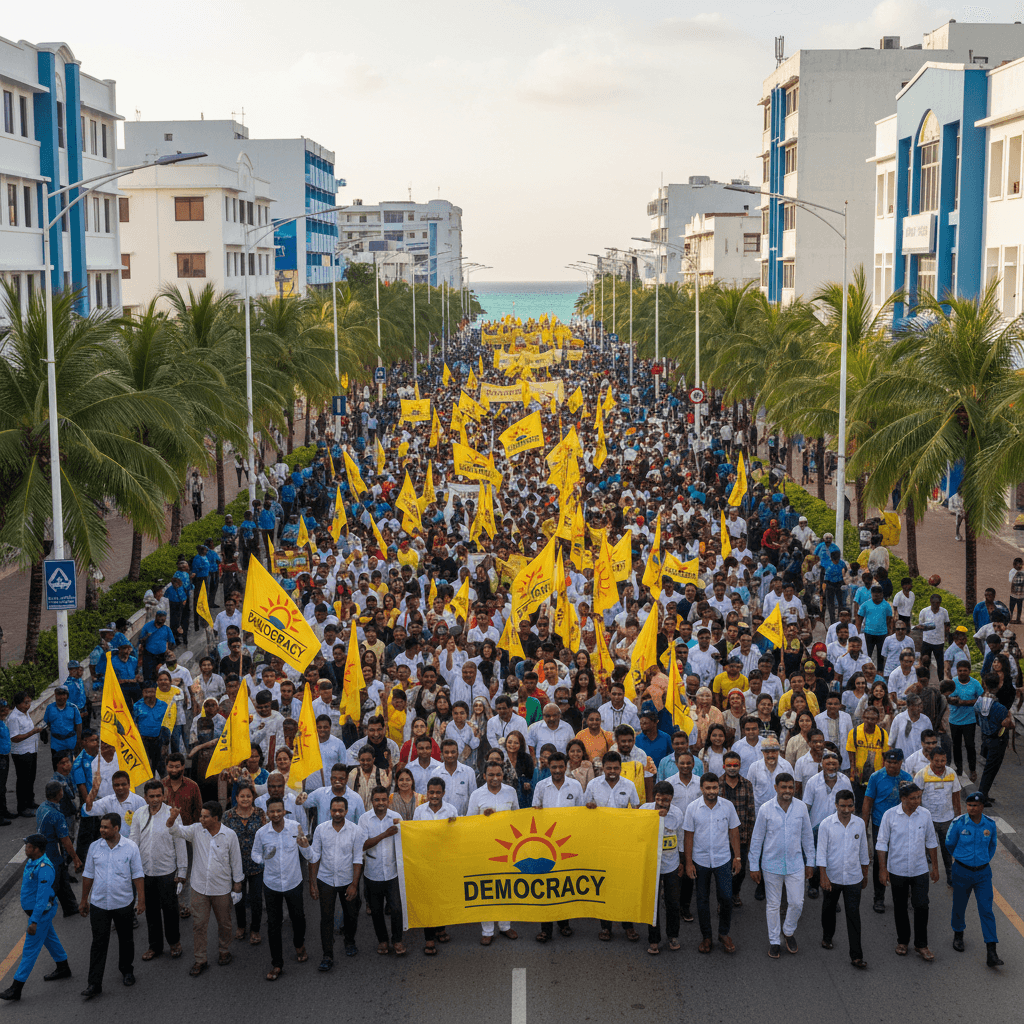
Yameen's base is built on social conservatism, Maldivian nationalism, and anti-India rhetoric. His PNF has signalled openness to coordination with the MDP opposition, congratulating their April 2026 victories — a remarkable tactical shift from a figure who once jailed opposition leaders.
However, Yameen's candidacy faces legal uncertainties. His 2022 conviction on money laundering charges (later overturned) and ongoing judicial proceedings could complicate his eligibility.
III. The Decisive Factors
The Economy: $1 Billion Question
The economy will likely be the defining issue. With $1 billion in debt servicing due in 2026 alone, public debt racing toward 135.7% of GDP, and over $1.3 billion owed to Chinese institutions, voters will demand credible economic plans. Tourism remains robust (5.5% GDP growth in 2024), but the gap between resort prosperity and atoll poverty continues to fuel resentment.
Geopolitics: The India-China Tightrope
Muizzu's signature “India Out” posture has quietly shifted toward pragmatic engagement as debt realities force a rethink. India has stepped in with financial support, seeking to reassert strategic interests. China holds 60%+ of sovereign debt. Every candidate will need a credible foreign policy that navigates this rivalry without compromising sovereignty — a nearly impossible balancing act.
Democratic Architecture
The referendum result proved that Maldivians care deeply about democratic checks and balances. Any candidate perceived as authoritarian or centralising will face headwinds. The anti-defection law, judicial independence, press freedom, and civil society space will all be battleground issues.
Climate & Existential Threat
The Maldives remains the world's lowest-lying nation. The Climate Adaptation Bill passed in 2026 established a framework, but implementation funding (the proposed $200M annual Climate Adaptation Fund) requires sustained political will. Climate credentials could be a differentiator, particularly for Nasheed, who built his international brand on this issue.
IV. Scenario Analysis: The Paths to Victory
Scenario A: United MDP vs Muizzu vs Yameen
Most likelyIf MDP unites behind a single candidate (likely Shahid or Nasheed), a three-way race heavily favours the opposition. The referendum showed MDP can command 42.9% outright. In a runoff against Muizzu, unified opposition support would be decisive.
Scenario B: Fragmented Opposition
Moderate riskIf MDP fails to unify — or if Nasheed runs independently — the opposition vote splits. This is Muizzu's best path to re-election: winning a plurality in the first round and consolidating in the runoff against a weakened opponent.
Scenario C: Yameen-MDP Tactical Alliance
Low but impactfulThe most unconventional scenario. Yameen's post-election congratulations to MDP signal openness. A formal or informal non-compete arrangement in certain constituencies could create an unstoppable anti-Muizzu coalition. Ideological contradictions make this fragile but not impossible.
Scenario D: New Entrant / Unity Candidate
Watch spaceA consensus figure emerges who can bridge MDP factions and attract PNF voters. This happened in 2018 when Solih — seen as a compromise candidate — defeated Yameen. History could repeat.
V. The Mood of the Nation
While no formal polling exists, the April 2026 results serve as the most reliable proxy for public sentiment. The data tells a clear story: urban Maldivians have turned against the PNC government. Male', Addu, Fuvahmulah, Kulhudhuffushi, and Thinadhoo all elected MDP mayors. The 75% referendum turnout — significantly above typical local election participation — suggests an electorate that is engaged, concerned, and willing to use democratic tools to express dissatisfaction.
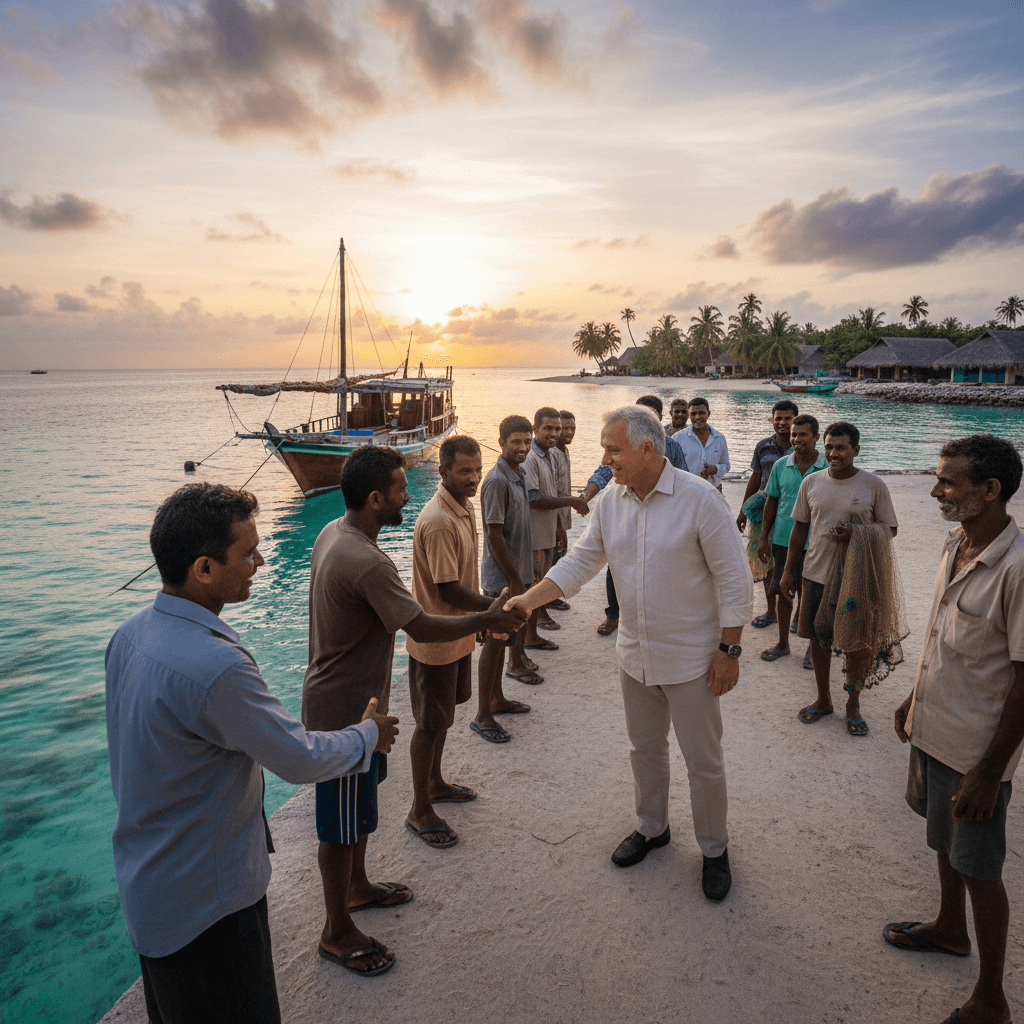
The outer atolls remain the battleground. PNC's 220 council seats versus MDP's 207 show that rural communities are more evenly divided. This is where the 2028 election will be won or lost: in fishing communities worried about quotas, in islands awaiting promised infrastructure, in families sending remittances from resort jobs.
“Will MDP take this mandate seriously, or will it repeat the established patterns of limited accountability? The fundamental question since 2008 remains: can any Maldivian government sustain democratic governance beyond the campaign?”
— Saif Fathih, Maldives Independent
VI. Timeline: What to Watch
Supreme Court ruling on anti-defection law — could reshape parliamentary dynamics
MDP leadership elections and presidential primary framework established
MDP presidential primary campaign begins; Yameen legal proceedings conclusion
MDP primary vote — the most important pre-election event
Coalition negotiations begin; economic data shapes campaign narratives
Formal campaign period; candidates announce running mates
Presidential election — first round; potential runoff within 21 days
VII. Conclusion
The 2028 Maldivian presidential election will be a referendum on the nation's democratic trajectory. The choices are stark: continuity under an embattled Muizzu, a return to MDP governance (but under which leader?), or a Yameen comeback that would test the limits of political reinvention.
What is clear is that the Maldivian electorate in 2026 is more engaged, more demanding, and more willing to punish incumbents than at any point in the nation's democratic history. The April referendum proved that constitutional mechanisms work, that voter turnout can be mobilised for democratic defence, and that even a parliamentary supermajority cannot override the public will.
The road to September 2028 will be long, turbulent, and consequential. Atoll Islands will be there every step of the way.
This analysis is based on publicly available electoral data, published reports from the Elections Commission of Maldives, ANFREL observer findings, Transparency Maldives assessments, and reporting from Maldives Independent, Anadolu Agency, and the Observer Research Foundation.
Mohamed Zahir
Editor-in-Chief
Mohamed Zahir has led the Atoll Islands editorial team since its founding. With 20 years in Maldivian journalism, he previously served as a BBC World Service correspondent.